Flat Roof Repair in Philadelphia: The Row Home Owner's Complete Guide
If you own a row home in Philadelphia, there's a good chance you're dealing with -- or will eventually deal with -- a flat roof issue. Flat roof repair in Philadelphia is one of the most common services we provide at Adilay Roofing, and for good reason: tens of thousands of Philadelphia row homes rely on flat roofing systems that face unique challenges most suburban homeowners never encounter.
Over 20+ years and 2,080+ completed projects, we've repaired and replaced flat roofs across every Philadelphia neighborhood from South Philly to Kensington, from West Philadelphia to the Northeast. This guide covers everything you need to know about keeping your flat roof in shape, what repairs cost, and when it's time to replace rather than patch.
Why Flat Roofs Are So Common in Philadelphia
Philadelphia's iconic row homes were designed to maximize living space on narrow lots. Flat roofs (or very low-slope roofs) allowed builders to use every inch of vertical space while keeping construction costs manageable across entire blocks of attached homes.
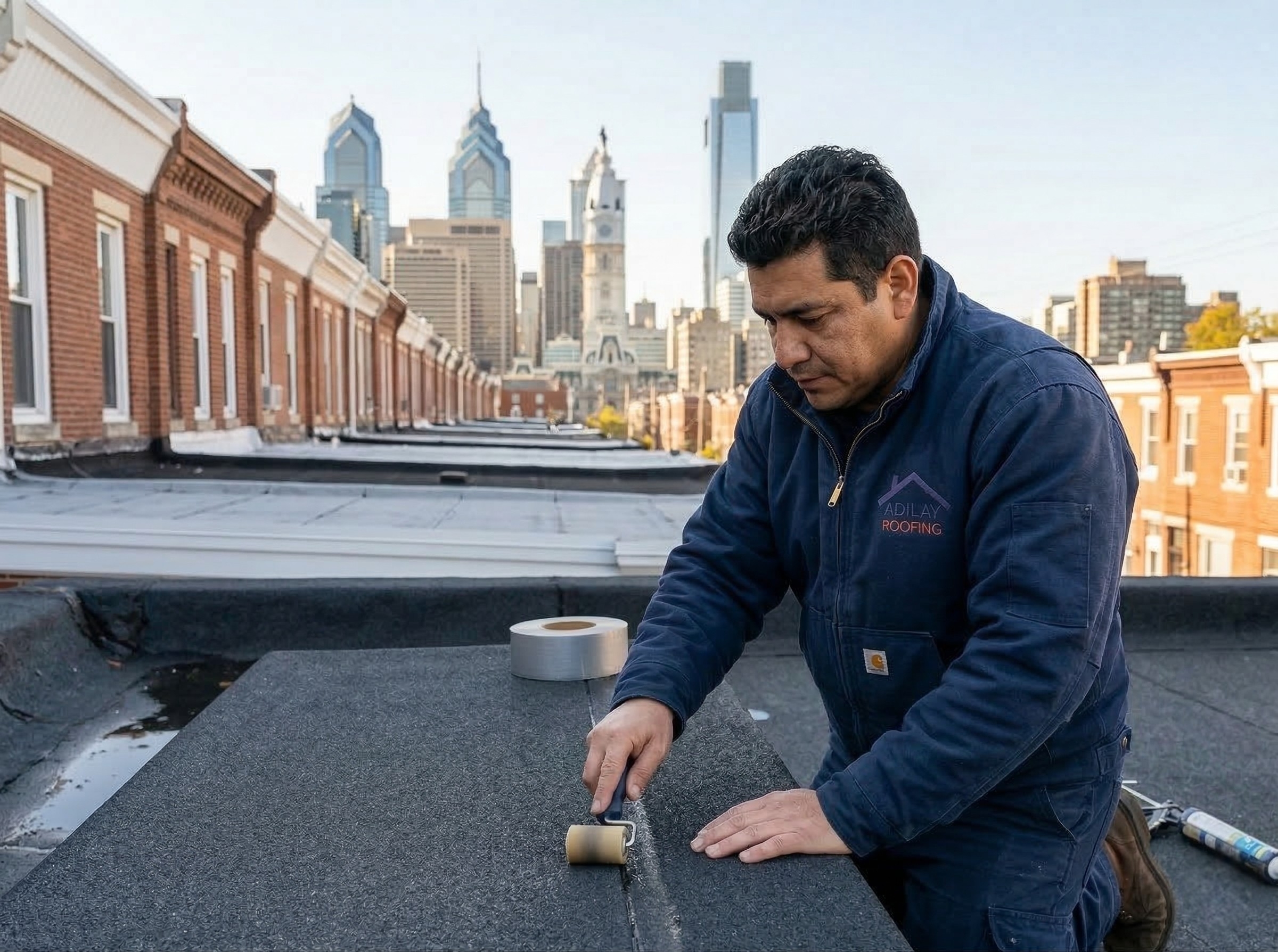
Walk down any street in South Philadelphia, Fishtown, Northern Liberties, Point Breeze, or Kensington, and you'll see block after block of flat-roofed row homes. Many of these homes were built in the late 1800s to mid-1900s, and while the original roofs have been replaced (sometimes multiple times), the fundamental flat roof design remains.
The challenge? Flat roofs are more vulnerable to water damage than pitched roofs because they don't shed water as quickly. Add Philadelphia's weather -- 40+ inches of rain per year, heavy snowfall from nor'easters, ice dams from freeze-thaw cycles, and blistering summer heat -- and you have a roofing system that demands regular attention.
Common Flat Roof Problems on Philadelphia Row Homes
Understanding the most common problems helps you catch them early. Here's what we see on row home roof repair calls throughout the city.
1. Ponding Water
Ponding is standing water that remains on the roof 48+ hours after rain. It's the most common flat roof issue in Philadelphia and can be caused by:
- Inadequate slope: Many older row homes were built with little to no drainage slope. Building codes today require a minimum 1/4 inch per foot slope, but homes built before the 1970s often don't meet this standard.
- Clogged drains: Leaves, debris, and sediment clog internal drains and scuppers, creating pools of standing water.
- Sagging decking: Over time, plywood decking can sag between joists, creating low spots that trap water.
Ponding water accelerates membrane deterioration, adds hundreds of pounds of weight to the structure, and is the leading cause of flat roof leak repair calls we respond to in neighborhoods like Passyunk, Bella Vista, and Graduate Hospital.
2. Membrane Damage and Deterioration
The waterproof membrane is your flat roof's first line of defense. Common membrane problems include:
- Blistering: Air or moisture trapped under the membrane forms bubbles that can crack and allow water in. This is especially common on older modified bitumen roofs during Philadelphia's hot summers.
- Cracking and splitting: UV exposure and thermal cycling cause membranes to harden and crack over time. South-facing roofs take the worst of it.
- Seam failure: Where membrane sheets overlap, adhesive or heat-welded seams can fail, creating a direct path for water.
- Punctures: Foot traffic, dropped tools, tree branches, and even birds can puncture flat roof membranes. If your row home roof doubles as a deck or you have HVAC equipment up there, puncture risk increases significantly.
3. Parapet Wall and Flashing Failures
This is the big one for Philadelphia row homes. The parapet walls -- the short walls that extend above the roofline at the front, back, and party walls -- are the most leak-prone areas on any row home roof.
Common parapet issues include:
- Failed counter-flashing: The metal flashing set into the parapet wall mortar joints deteriorates over time, allowing water to run behind the membrane.
- Mortar deterioration: The mortar between bricks in parapet walls erodes from decades of weather exposure, creating paths for water infiltration.
- Coping stone failures: The cap stones or metal coping on top of parapet walls can shift, crack, or lose their sealant, letting water into the wall itself.
- Party wall gaps: Where your roof meets your neighbor's, small gaps or flashing failures can cause leaks that are difficult to trace because water can travel along the shared wall before emerging inside.
Party wall issues are the number one reason Philadelphia row home owners call us for flat roof repair in Philadelphia. Getting them right requires experience with the specific construction methods used in Philly row homes, not generic flat roof techniques.
4. Drainage System Problems
Flat roofs rely on internal drains, scuppers, or gutters to move water off the roof. When these systems fail, water has nowhere to go but through the membrane. Watch for:
- Clogged internal drains: Leaves, roofing granules, and debris accumulate at drain points
- Rusted or deteriorated scuppers: The metal openings in parapet walls that direct water to downspouts can corrode
- Inadequate drainage design: Some older row homes have only one drain point for the entire roof -- if it clogs, the roof becomes a bathtub
Flat Roof Repair Types and Costs
The cost of flat roof repair in Philadelphia varies widely based on the type and extent of damage. Here's what you can expect:
Minor Repairs: $300 - $1,500
- Patching small punctures or tears
- Resealing seams
- Clearing clogged drains
- Replacing small sections of flashing
- Applying rubber roof repair patches to isolated problem areas
Moderate Repairs: $1,500 - $5,000
- Replacing sections of damaged membrane (partial re-roofing)
- Repairing or replacing parapet wall flashing
- Addressing ponding issues with tapered insulation on limited areas
- Fixing multiple leak points
- Repointing parapet wall mortar and installing new counter-flashing
Full Flat Roof Replacement: $3,000 - $13,000
- Complete tear-off and replacement of the entire membrane system
- Decking repair or replacement where needed
- New insulation with proper slope for drainage
- Full flashing replacement at all parapet walls, penetrations, and edges
- New drainage components
The wide range in replacement cost depends on roof size, material choice, and how much structural work is needed. A standard 14x40 foot row home flat roof section typically costs $4,500 to $8,000 for a complete EPDM or TPO replacement.
For a detailed breakdown of repair costs throughout Philadelphia, see our comprehensive roof repair cost guide.
Flat Roof Membrane Options for Philadelphia Row Homes
When it's time to replace your flat roof membrane, you have several options. Each has strengths and weaknesses for Philadelphia flat roofing applications.
EPDM Rubber Roofing
EPDM (Ethylene Propylene Diene Monomer) is the most popular flat roof material for Philadelphia row homes, and for good reason:
- Lifespan: 20-30 years
- Cost: $4.00 - $8.00 per sq ft installed
- Pros: Excellent flexibility in cold weather (critical for Philadelphia winters), UV resistant, easy to repair, proven track record
- Cons: Black color absorbs heat, seams require careful installation
EPDM is our most-recommended material for Philadelphia row homes because of its proven performance in our climate. The flexibility of rubber means it handles freeze-thaw cycles without cracking, unlike some rigid membrane systems. Read our complete EPDM rubber roofing guide for a deep dive into this material.
TPO (Thermoplastic Polyolefin)
- Lifespan: 20-30 years
- Cost: $5.50 - $9.00 per sq ft installed
- Pros: White reflective surface reduces cooling costs, heat-welded seams are extremely strong, chemical resistant
- Cons: Higher initial cost, less flexible than EPDM in extreme cold
TPO is a great choice for homeowners looking at energy savings. The white surface can reduce attic temperatures significantly during Philadelphia's humid summers.
Modified Bitumen
- Lifespan: 10-20 years
- Cost: $3.50 - $6.50 per sq ft installed
- Pros: Familiar to many roofers, good multi-layer waterproofing, torch-applied or self-adhered options
- Cons: Shorter lifespan, torch application carries fire risk on row homes, less flexible than EPDM
Modified bitumen is still widely used but is gradually being replaced by EPDM and TPO in our region due to their longer lifespans and better performance characteristics.
The Row Home Factor: What Makes Philadelphia Flat Roofing Different
Generic flat roof repair advice doesn't always apply to Philadelphia row homes. Here's what makes our city's row home roof repair challenges unique.
Party Wall Coordination
When your flat roof meets your neighbor's roof at the party wall, you share responsibility for that junction point. If your neighbor's flashing is failing and sending water toward your side, your roof pays the price. We often recommend talking with neighbors before major repairs so both sides of the party wall get addressed simultaneously.
Access Challenges
Many Philadelphia row homes have no rear alley access, which means roofing materials and debris need to go up and over the building or through the house. In neighborhoods like Bella Vista, Queen Village, and parts of Fishtown, streets are narrow and parking is scarce, adding logistical challenges. Our crews are experienced with these constraints -- we don't charge extra for difficult access because it's standard for the work we do every day.
Multiple Roof Levels
Many row homes have a two-story front section and a one or three-story rear addition, creating multiple flat roof levels with transitions between them. Each transition is a potential leak point that requires careful flashing and membrane detailing. The "kitchen roof" on many Philadelphia row homes -- the low flat section over a rear addition -- is notorious for leaks.
Historic Considerations
In historic neighborhoods like Society Hill, Old City, and parts of Germantown, there may be additional requirements for visible roofing elements. While flat roofs are generally not visible from the street, any work on parapet walls or visible flashing may need to comply with historical commission guidelines.
How to Maintain Your Philadelphia Flat Roof
Preventive maintenance is the most cost-effective way to extend your flat roof's life and avoid emergency flat roof leak repair calls.
Seasonal Maintenance Checklist
Spring (March-April):
- Clear all debris, leaves, and branches from the roof surface
- Check and clear all drains, scuppers, and gutters
- Inspect for winter damage: cracking, lifting seams, ice-dam damage at eaves
- Check parapet wall flashing and coping stones for movement or damage
Summer (June-July):
- Inspect membrane for blistering (heat-related damage)
- Check sealant around all penetrations (vents, pipes, HVAC units)
- Trim overhanging tree branches
Fall (October-November):
- Thorough drain cleaning before winter rains and snow
- Remove all leaves and debris
- Inspect and repair any damaged flashing before freeze-thaw cycles begin
- Consider a professional pre-winter inspection
Winter (As needed):
- After heavy snowfall, check for excessive accumulation (more than 12 inches of heavy wet snow should be removed carefully)
- After nor'easters, check for ice dams and backed-up drains
- Monitor interior ceilings for water stains, which indicate active leaks
For a more detailed guide, see our seasonal roof maintenance checklist for Philadelphia.
When to Call a Professional
Some maintenance you can handle yourself. But call a professional when:
- You find an active leak
- Standing water remains more than 48 hours after rain
- You see large blisters, splits, or membrane separation
- Flashing is pulling away from walls
- You notice sagging in the roof structure
- Any damage after a major storm
Why Adilay Roofing for Your Flat Roof Repair
Flat roofs require specialized expertise that not every roofing contractor has. At Adilay Roofing, flat roof work on Philadelphia row homes is a core part of what we do -- not a sideline. Here's why homeowners across Philadelphia trust us with their flat roofs:
- Row home specialists. We've worked on hundreds of Philadelphia row homes and understand the unique challenges of party walls, tight access, multi-level roofs, and aging infrastructure.
- No subcontractors. Our own trained crews do every job. On flat roofs, where attention to detail at seams and flashings is everything, this matters more than you might think.
- Licensed and insured. PA license PA184779, active through July 2027. Full liability and workers' compensation coverage.
- Honest assessments. If your flat roof needs a $500 patch, we'll tell you that -- not sell you a $5,000 replacement you don't need. Our experienced team has built our reputation on trust.
- 2,080+ completed projects. See our completed projects across Philadelphia neighborhoods.
We serve all of Philadelphia plus Bucks County, Montgomery County, Delaware County, and Chester County. Check our areas we serve page for full coverage details.
Get Your Flat Roof Inspected Today
Whether you're dealing with an active leak, ponding water, or just want peace of mind before the next big storm, a professional inspection is the first step. We'll identify any issues, explain your options, and give you a straight answer on whether you need a repair or replacement.
Get a free roof estimate or call (888) 823-4766. We're available Sunday through Friday, 24 hours a day, with 24/7 emergency service for active leaks. For our flat roofing services, no job is too small or too complicated.
Adilay Roofing LLC 2020 Dreer St., Unit 101, Philadelphia, PA 19125 PA License: PA184779
Your Philadelphia flat roof specialists -- serving the city and surrounding counties with expert, honest roofing since 2004.