Slate Roof Repair vs. Replacement: A Philadelphia Homeowner's Guide
If you own a home with a slate roof in Chestnut Hill, Germantown, Mount Airy, or one of Philadelphia's other historic neighborhoods, you have something most American homeowners don't — a roofing material that can outlast multiple generations of owners. Done right, a natural slate roof installed today will still be on your house in the year 2120. Done wrong, or maintained badly, that same slate roof can leak repeatedly for years and eventually push you toward an unnecessary $40,000 replacement.
The single most important thing to understand about slate roofs is this: slate itself almost never fails. Slate is metamorphic rock. It survives rain, snow, ice, UV radiation, and 100°F summer heat without aging in any meaningful way. What fails on slate roofs is everything around the slate — flashings, mortar joints, ridge caps, valleys, fasteners — and most of those failures are repairable.
This guide walks you through how to know which category your roof falls into: the one that needs targeted repair, or the one that's genuinely reached end of life and needs replacement.
Need an honest assessment now? Request a free slate roof inspection or call (888) 823-4766 — we'll come out, climb the roof, and tell you straight whether you need repair or replacement.
The Most Common Slate Roof Problems in Philadelphia (and What They Mean)
Almost every slate roof inspection we do in Chestnut Hill, Germantown, and Mount Airy turns up one or more of the following issues. Importantly, none of these alone usually means you need a full replacement — they're maintenance items on a roof system that can keep going for decades.
1. Slipped or Missing Individual Tiles
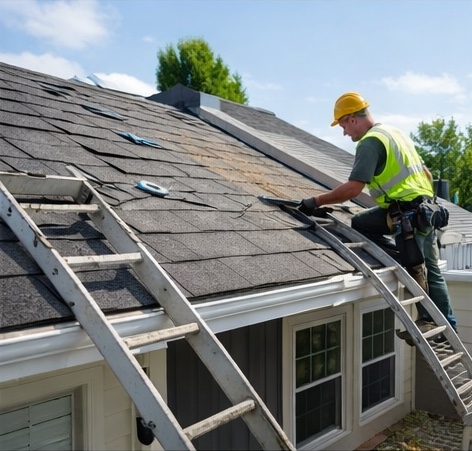
The most common visible issue. A single slate tile slips out of position or falls off entirely. This happens because the original copper or galvanized nail holding it has finally corroded through, or because freeze-thaw movement over decades has worked the slate loose. One or two slipped slates per year on a 100-year-old roof is normal and easily fixed — we replace the missing slate using a slate hook (so we don't disturb adjacent pieces) and call it done.
When it becomes a replacement signal: if you're losing five or more slates per year and the pattern is spreading across the roof, the underlying nails are failing system-wide (see "nail sickness" below).
2. Failed Flashings Around Chimneys and Skylights
This is the #1 cause of leaks on otherwise-sound slate roofs. The original copper or lead flashing that seals where the slate meets the chimney, skylight, or wall transition has corroded, separated from the masonry, or been incorrectly repaired in the past with caulk or roof cement (a common amateur mistake). Water gets in at the flashing, runs down the inside of the wall, and shows up as a stain in your attic or top-floor ceiling.
The fix: replace the flashing in the affected area with new copper or lead, properly stepped under the slate above and over-counter-flashed at the masonry. This is a half-day to one-day job and typically extends the life of the surrounding slate field by another 20-30 years.
3. Lifted or Failed Ridge Caps
The ridge — the very peak of the roof — is typically capped with either matching slate ridge pieces set in mortar or copper ridge caps. Mortar weathers and cracks over decades; copper can corrode at fastener points. Lifted ridge caps let wind-driven rain into the attic during storms.
The fix: re-point or rebuild the ridge using fresh mortar matched to the original color, or replace failed copper ridge caps with new copper.
4. Valleys With Failed Membranes Underneath
Slate roofs use either open metal valleys (visible copper or lead in the valley) or closed valleys with the slate cut to meet at the centerline. In either case, there's a metal flashing running underneath. After 60-80 years that metal can corrode, especially under heavy debris from Philadelphia's mature tree canopy in Mount Airy and Germantown.
The fix: remove the slate adjacent to the valley, replace the underlying metal valley flashing, and reset the slate. A specialty job, but routine for slate-experienced roofers.
5. Damage From Tree Limbs or Roof Workers
Random impacts crack slate. A tree limb falling on the roof, a careless HVAC technician walking on the roof to service a unit, a chimney sweep — any of these can crack two or three pieces. Easy individual replacement.
When Repair Is Genuinely Not Enough — The Replacement Decision
After about 80-100 years on a typical Pennsylvania slate roof, you may genuinely reach a point where repair stops being the right answer. Here are the four signs we look for:
Sign 1: Widespread Surface Delamination
The slate itself starts to flake apart in thin layers. Run your hand along the surface and small chips come off. This is rare in good Pennsylvania slate (which is some of the highest-quality slate ever quarried in North America) but more common in lower-grade slates that may have been used on outbuildings or lower-cost installations.
Sign 2: Nail Sickness System-Wide
This is the big one. The original fasteners — typically copper-plated steel or hand-cut copper nails — have corroded enough that the slate can no longer be reliably attached to the roof deck. You can tell when slates that get re-nailed during repair work fall back off within a year or two, and when individual repairs aren't holding the way they used to. At that point, the roof has hit fastener-driven end of life. The slate may still be perfectly good — and sometimes can even be reclaimed and reinstalled — but the system as a whole needs to come off and go back on with new fasteners.
Sign 3: Multiple Slope Failures Per Year
If you're calling a slate roofer 4-6 times a year for individual leaks coming from different parts of the roof, the math tips toward replacement. The cumulative cost of constant repair starts to outpace the cost of a full re-roof, and the repeated water intrusion is damaging the underlying decking and framing.
Sign 4: Visible Decking Failure
If you can see daylight through the roof from inside the attic, or if sections of the underlying wood decking have rotted through from prolonged water exposure, you're past the repair-vs-replace decision and into structural-repair territory.
Three Replacement Options When the Time Comes
If your slate roof has genuinely reached end of life, you have three real choices:
Option 1: Natural Slate Replacement
The historic-correct, longest-lasting option. We tear off the old slate, replace any failed decking, install new ice-and-water shield underlayment, and lay a new slate roof using either reclaimed slate (where feasible — sometimes your original slate can be salvaged and reused) or new Pennsylvania, Vermont, or Virginia quarry slate matched to your home's character.
- Service life: 75-100+ years
- Cost on a typical Philadelphia twin or detached Victorian: $25,000-$60,000+
- Best for: Homes inside designated historic districts (Chestnut Hill, parts of Germantown and Mount Airy) where PHC review applies; homeowners who plan to stay in the home long-term and want the original look preserved
Option 2: Synthetic (Composite) Slate
Recycled rubber and polymer products engineered to look like real slate. Modern synthetic slate is genuinely difficult to distinguish from natural slate at street level, weighs less than natural slate (which can matter for older roof structures), and comes with manufacturer warranties of 50 years.
- Service life: 50-year manufacturer warranty
- Cost on the same home: $14,000-$30,000
- Best for: Homeowners outside designated historic districts who want the slate look at roughly half the cost of natural slate; homes where the existing roof structure isn't rated for the full weight of natural slate without reinforcement
Option 3: Heavy Architectural Shingle in a Slate Profile
The most affordable option. Designer shingle profiles like CertainTeed Grand Manor or GAF Slateline are dimensional asphalt shingles cut and shadowed to give a credible slate appearance from the ground.
- Service life: 30-50 year warranties (typically 50)
- Cost on the same home: $10,000-$18,000
- Best for: Philadelphia homes outside historic districts where a slate-like appearance matters but the budget doesn't justify natural or synthetic slate
We'll bring samples of all three to the on-site estimate so you can compare them against your existing roof and your neighbors' homes before deciding.
Historic District Considerations
Several Philadelphia neighborhoods have designated historic districts where roof material changes are reviewed by the Philadelphia Historical Commission (PHC):
- Chestnut Hill Historic District — material reviews active for changes visible from public right-of-way
- Colonial Germantown Historic District — large stretches of Germantown Avenue and surrounding streets
- Tulpehocken Station Historic District — the area around the SEPTA station and surrounding Victorian streetscapes
- Awbury Historic District and Deshler-Morris House surrounds — smaller designated zones with active review
Inside these districts, switching from natural slate to synthetic slate or to architectural shingle typically requires PHC approval before the permit can be pulled. We file the Application for Building Permit with Historical Review, submit material samples and shop drawings if requested, and don't start work until approval comes through.
Outside the designated districts — which is most of Mount Airy, most of Germantown's residential streets, and parts of Chestnut Hill — standard L&I permitting applies and we handle that as part of every project.
Getting an Honest Assessment
The slate roofing world has its share of contractors who will look at any leak and recommend a $40,000 replacement when a $1,200 flashing repair would solve the problem for another 25 years. Don't be fooled into a premature replacement.
We've worked on slate roofs across Chestnut Hill, Germantown, Mount Airy, Wissahickon, and the rest of Philadelphia's slate-roofed neighborhoods for 20+ years. We carry the right tools (slate hooks, copper flashings, slate-cutting equipment, color-matched mortar), we have suppliers who can match aging Pennsylvania slate, and we know the difference between a roof that needs repair and a roof that's truly reached end of life.
Schedule a free slate roof inspection or call (888) 823-4766. We'll climb the roof, take photographs of every issue we find, and give you a written assessment that tells you exactly what's needed and what it costs — repair OR replacement, whichever the roof actually requires.
For neighborhood-specific roofing pages with more local context, see Germantown roofing, Manayunk roofing, or our full Philadelphia roofing service page.